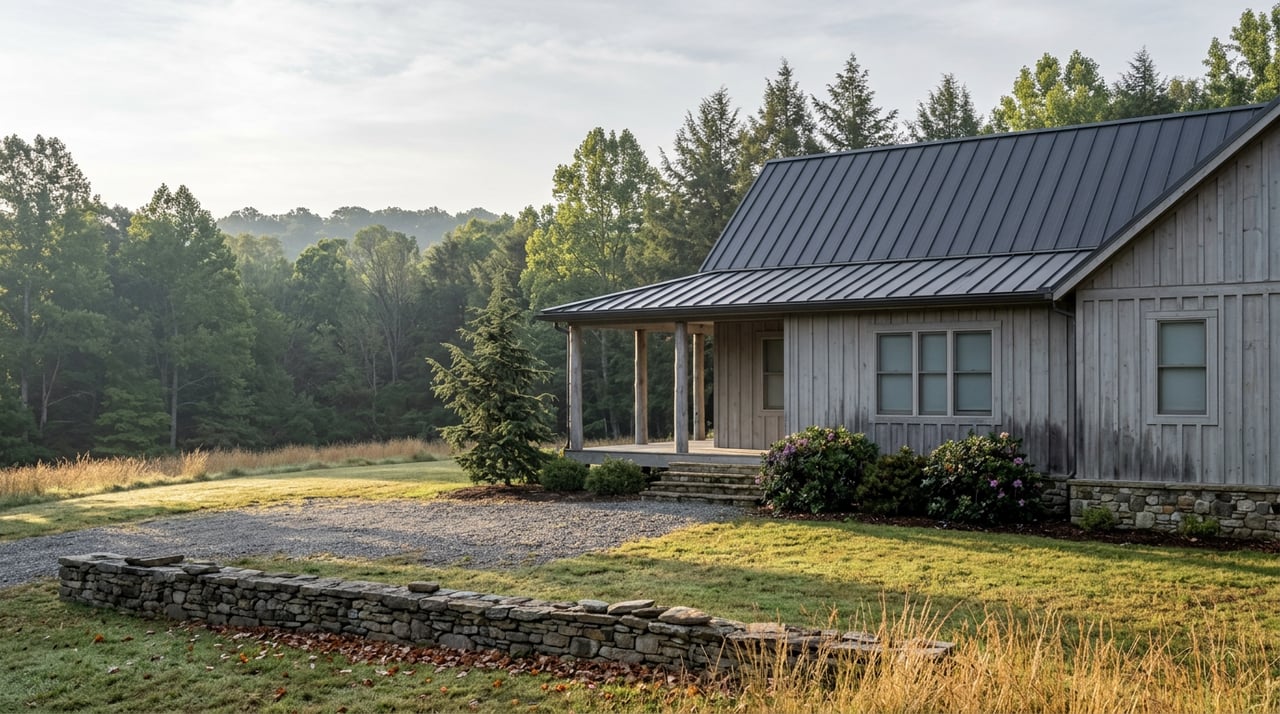
What "Unrestricted" Really Means When You're Buying Land Near Burnsville
September 10, 2026
September 10, 2026
Every third listing for raw acreage near Burnsville uses the same word: unrestricted. No zoning, no HOA, no covenants telling you what color to paint a barn or whether you can park an RV on your own dirt. It reads like freedom, and in the ways that matter for a subdivision fight over fence height, it is.
But unrestricted only describes what the county government and a homeowners association won't tell you to do. It says nothing about whether the ground under that pretty view will actually pass a septic evaluation, or who is responsible for grading the gravel road you'll drive in on every winter. Those two questions decide whether a tract is buildable long before anyone checks a zoning map. On steep Yancey County ground, they're also the two things a listing photo can never show you.
"Unrestricted" is a legal description of what doesn't exist on a parcel: no zoning ordinance, and often no recorded deed restrictions either. It is not a statement about soil, slope, or access. A tract can be completely unrestricted and completely unbuildable in the same sentence, if the soil under it can't support a septic system and no engineered alternative gets designed for it.
That distinction matters more in the mountains than almost anywhere else in North Carolina. The same freedom that lets you park a camper or run a small hobby farm without a covenant board's approval also means nobody has already solved the hard questions for you. In a platted subdivision with an HOA, someone typically worked out the road maintenance agreement and the shared well arrangement years ago. On unrestricted mountain acreage, that work is still sitting on the table when you make an offer, and it becomes yours to finish.
North Carolina retired the old perc test years ago in favor of a soil morphology evaluation, a licensed soil scientist digs test pits and studies texture, structure, color, and depth to bedrock rather than just timing how fast a hole drains on one particular afternoon. On January 1, 2024, the state overhauled the rules governing that process under 15A NCAC 18E, the biggest change to on-site wastewater regulation in 34 years, and Yancey County is named specifically as one of the mountain region counties where steep slopes and shallow bedrock make conventional systems the exception rather than the rule.
Soil depth on Yancey County's mountain slopes rarely exceeds 18 inches before hitting rock. That single fact is why alternative systems like low-pressure pipe or drip irrigation show up so often on mountain tracts instead of a standard gravity-fed drainfield, and why an alternative system costs more to design and install. The Yancey County Health Department, part of the Toe River Health District that also covers Avery and Mitchell counties, handles the soil evaluation and issues the Improvement Permit that confirms a lot can support a system at all. Without that permit, or with an expired one, you are buying a guess.
Here is what that looks like on real ground currently listed near Burnsville:
| Tract | What's already documented | What's still open |
|---|---|---|
| A roughly 7-acre parcel off Bolens Creek Road | Already perc'd for a 3-bedroom septic system, with over 1,000 feet of creek frontage and private road access | Whether the permit is current and whether a repair area was also mapped |
| A 49-acre unrestricted tract on Windy Gap Road near the Madison-Yancey line | Underground power and private road access already installed, plus other stated improvements | Road maintenance responsibility, since there's no HOA to formalize it |
| A riverfront parcel on the Cane River affected by flooding | Power runs to the site and a well and septic existed before the storm | Power was never reconnected, and the well and septic status is listed as unknown |
The gap between the first two rows and the third is the whole argument. A tract with a documented Improvement Permit and installed utilities has already absorbed the risk that a buyer would otherwise be taking on cold. A tract where the septic status is simply unknown is asking you to price that risk yourself, and on Yancey County's terrain, an unfavorable soil evaluation can turn a buildable lot into recreational land overnight.
North Carolina's standard residential contract, Form 2-T, is built around a due diligence fee that most states don't use. A buyer pays it directly to the seller for the right to walk away for any reason, or no reason, before a set deadline. It's not a deposit held in escrow against a specific contingency like financing or inspection. It's money in the seller's hand the moment you sign, and once the due diligence period ends, that protection ends with it. Walk away a minute after the deadline and both the fee and your earnest money are gone.
That structure changes the order of operations on raw land. In many states, an inspection contingency lets you investigate first and negotiate your exit after. In North Carolina, the exit only exists inside a window you and the seller agreed to up front, which means the soil evaluation, the well and septic history, and the road access question all need answers before that window closes, not after. A county soil evaluation can take several weeks depending on scheduling, which is exactly why a short due diligence period on a land deal is often the first mistake a buyer makes, not the last.
Here's the part that surprises people who assume unrestricted land should be the cheapest kind on the market, since it comes with none of the guardrails a subdivision buyer pays for. Current listings across Yancey County put plain undeveloped acreage at an average of roughly $8,891 per acre, while parcels specifically marketed as unrestricted average closer to $12,672 per acre. Unrestricted land is pricier, not cheaper, than raw undeveloped ground.
The reason isn't the word itself. It's what tends to travel with it. Look back at the Bolens Creek Road and Windy Gap Road tracts: both are marketed as unrestricted, and both also come with a documented perc permit or installed power and road access already in place. Sellers who've done that groundwork price it in, because they're not selling a question mark, they're selling an answer. A buyer paying $12,672 an acre for unrestricted land isn't paying for the absence of zoning. They're often paying for someone else's already-finished due diligence.
That reframes the negotiation. If a listing calls itself unrestricted but can't produce a current Improvement Permit or documentation on the road, the premium over plain undeveloped land isn't buying you anything, and there's room to talk price. If it can produce that documentation, the premium is arguably fair, because you're buying certainty instead of risk.
A few questions turn "unrestricted" from a marketing word back into a checklist:
Does unrestricted mean I can put any type of home on the land? Not automatically. Unrestricted usually means no zoning ordinance and often no recorded deed restrictions, but some tracts still carry older recorded covenants limiting things like mobile homes even without an active HOA enforcing them. Always review the title work, not just the listing description.
If a soil evaluation comes back unfavorable, is the lot a total loss? Not necessarily. An unfavorable result for a conventional gravity system often still leaves room for an engineered alternative like a low-pressure pipe system, though it adds cost. In rarer cases the soil genuinely can't support any on-site system, which is exactly why getting that evaluation done during due diligence, rather than after closing, protects your money.
Land near Burnsville rewards patience more than speed. The tracts that hold their value are the ones where someone already answered the hard questions, and the ones that turn into headaches are the ones where "unrestricted" was mistaken for "already checked out." If you're looking at a piece of ground and want help reading what's actually documented versus what's just implied, Alli Buchanan has spent her career in these exact hills and is glad to walk through it with you. Let's Connect.
Stay up to date on the latest real estate trends.
Whether buying, selling, or relocating, partner with Alli for local expertise, honest guidance, and dedicated support from consultation to closing.